The Order of the Lily and the Eagle

Study of the Tableau Naturel
|
Etude sur la Tableau
|
Study of the Natural
|
INTRODUCTIONCe document fournit une traduction côte à côte du français vers l'anglais d'un article «ÉTUDE sur le TABLEAU NATUREL» de LouisĂClaude de SaintĂMartin, trouvé dans La Revue EON série 2, publiée de 1923 à 1925. |
INTRODUCTIONThis document provides a side-by-side French to English translation of an article "Study of the NATURAL TABLEAU" by LouisĂClaude de SaintĂMartin, found in La Revue EON series 2, that was published from 1923 to 1925. |
|
Cette étude est un œuvre produit par un SÐ IÑ (Dimitri Sémélas) pour la formation martiniste de l'OL+A, afin de fournir un guide informatif et utile à cette œuvre par LouisĂClaude de SaintĂMartin. |
This study is a work produced by a SÐ UÑ (Dimitri Sémélas) for the Martinist formation of the OLE, to provide an informative and helpful guide to this seminal work by LouisĂClaude de SaintĂMartin. |
|
Nous espérons que le lecteur trouvera un bon usage de cette traduction et toute remarque ou suggestion sera la bienvenue. |
We hope the reader can find good use for this translation and any comments or suggestions would be welcomed. |
|
KePu Novembre 2024 |
KePu November 2024 |
|
|
|
|
|
|
|
|
|
|
Sur cette base, nous encourageons l'adhérent et l'initié à faire leur propre étude du 7ème chapitre du Tableau Naturel pour leur propre édification. |
Based on this, we encourage the adherent and initiate to make their own study of the 7th chapter of the Natural Tableau for their own edification. |
|
|
|
|
|
ÉTUDE sur le TABLEAU Par un SÐ IÑ
|
Study of the NATURAL By a SÐ UÑ
|

|
Le Tableau Naturel des Rapports qui existent entre Dieu, l'Homme et l'Univers, par LouisĂClaude de SaintĂMartin, dit le Philosophe Inconnu, est un ouvrage supérieur qui traite de la Nature de l'Homme et de ses rapports avec l'Univers et Dieu. |
The Natural Tableau of the Relation between God, Man and the Universe, by LouisĂClaude de SaintĂMartin, known as the Philosopher Unknown, is a superior work which deals with the Nature of Man and its relationships with the Universe and God. |
|
Ayant, plusieurs fois, étudié cet ouvrage, j'ai entrevu les difficultés qui surgissent à celui qui veut en pénétrer le sens. |
Having studied this work several times, I glimpsed the difficulties that arise for those who want to understand its meaning. |
|
J'ai donc pensé rendre service à ceux qui sont désireux de connoître la philosophie de LouisĂClaude de SaintĂMartin, en exposant, sous forme de Théorèmes, les idées principales et essentielles de chacun des chapitres de l'ouvrage. |
I thought therefore, I would be of service to those who wish to know the philosophy of LouisĂClaude de SaintĂMartin, by presenting the principal and essential ideas of each chapter in the form of Theorems. |
|
J'ai aussi conçu un Arcane Symbolique pouvant traduire par ce mode l'idée dominante de chaque chapitre pour ceux qui désirent méditer sur des objets utiles à l'évolution des Êtres. |
I have also conceived a Symbolic Arcanum that can translate the dominant idea of each chapter for those who wish to mediate on objects that are useful for the evolution of Beings. |
|
|
Par un SÐ IÑ |
By an SÐ UÑ |
|
ÉTUDE sur le TABLEAU Chapitre VI Par un SÐ IÑ La Revue EON 19 et 20 janvier-février 1925
|
Study of the NATURAL Chapter VI By a SÐ UÑ Revue EON 19 et 20 January-February 1925
|

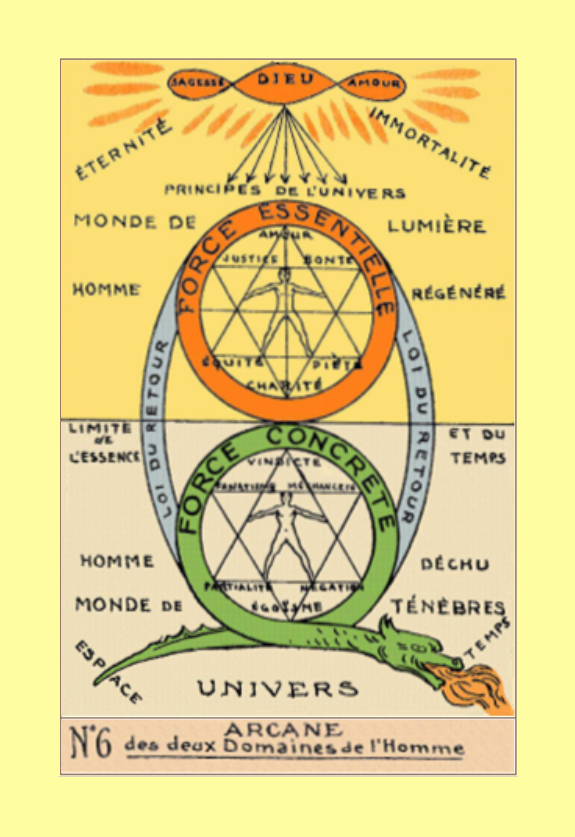
|
ÉTUDE sur le TABLEAU Par un SÐ IÑ (Suite) La Revue EON 19 et 20 janvier-février 1925
Chapitre VI |
Study of the NATURAL By a SÐ UÑ (Sequel) Revue EON 19 et 20 January-February 1925
Chapter VI |
|
THÉORÈME I 135 Ce serait ici le lieu de jeter du jour sur le premier crime de l'homme. Nous pourrions même remarquer à ce sujet que l'homme n'apporte au monde que des regrets et non pas des remords; encore ces regrets sont-ils ignorés du plus grand nombre, parce qu'on ne peut avoir de la douleur que pour les maux qu'on connaît, parce qu'on ne peut connaître et sentir les maux premiers qu'avec beaucoup de travaux, et que la plupart des hommes n'en font aucun. Voilà ce qui rend la vérité de ce crime si incertaine à leurs yeux, tandis que ses effets sont si manifestes. |
THEOREM I 135 Here is the place to shed some light on a person's original crime. In this regard, we can remark that a person brings to this world only regrets but not remorse. Yet these regrets are unknown to the majority of people, as we can only have grief for the evils that we know about, and because those original evils can only be known and felt after a great deal of effort, which most of us do not make. This is why the truth of this crime is so uncertain in their eyes, even though its effects are so obvious. |
|
THÉORÈME II 136 Nous pouvons croire que le crime de l'Homme fut d'avoir abusé de la connaissance qu'il avait de l'union du principe de l'Univers avec l'Univers. Nous ne pouvons douter même, que la privation de cette connaissance, ne soit la vraie peine de son crime, puisque nous subissons tous cette irrévocable punition, par l'ignorance où nous sommes sur les liens qui attachent notre être intellectuel à la matière. |
THEOREM II 136 We can believe that a person's crime was to have abused the knowledge of the union of the principle of the Universe with the Universe. We cannot even doubt that the loss of this knowledge is the real penalty for their crime, since we all suffer this irrevocable punishment, due to ignorance of the links that attach our intellectual being to matter. |
|
THÉORÈME III 137 La preuve manifeste que cette connaissance ne peut nous être parfaitement rendue pendant notre séjour sur la Terre, c'est que n'étant dans ce bas Monde, que pour subir la privation de la Lumière que nous avons laissé échapper, si nous pouvions y recouvrer pleinement cette lumière, nous ne serions plus en privation et par conséquent nous ne serions plus dans ce bas monde. |
THEOREM III 137 The clear proof that this knowledge cannot be perfectly restored to us during our stay on Earth is that being in this base World, is to suffer to the deprivation of the Light that we have let slip, if we could fully recover this light, we would no longer be in deprivation and as a consequence, we would no longer be in this world. |
|
THÉORÈME IV 138 En ne considérant la lumière élémentaire que dans ses effets relatifs aux trois règnes terrestres, nous remarquerons que les minéraux étant enfouis dans la terre sont totalement privés de cette lumière; que les végétaux n'en sont point privés, mais qu'ils la reçoivent sans la voir et sans en jouir[1]; que les animaux la voient et en jouissent, mais qu'ils ne peuvent ni la contempler ni pénétrer dans la connaissance de ses lois; enfin, que ce dernier privilège est réservé à l'homme, seul ou à tout Être doué comme lui des facultés de l'intelligence. |
THEOREM IV 138 If we consider elemental light only by its effects relative to the three terrestrial kingdoms, we will note that minerals buried in the earth are totally deprived of this light; that plants are not deprived of it, but they receive it without seeing it or enjoying it[2]; that animals see and enjoy it, but they can not either contemplate it or penetrate into the knowledge of its laws; finally, that this last privilege is reserved for people alone, or to any Being like them that is endowed with the faculties of intelligence. |
|
[1] Ici nous ne considérons pas la chose au point de vue de l'hèliotropism. [2] The original footnote text is given in [1] above: Here, we do not consider this matter from the point of view of heliotropism. {The motion of plant parts in response to the direction of the Sun.} |
|
THÉORÈME V 139 C'est là où nous apprendrons à reconnaître tout ce qui nous manque pour posséder la lumière intellectuelle; il y a des Êtres intelligents qui sont totalement séparés de cette lumière, il y en a qui n'en sont point séparés, mais qui ne participent à ces effets qu'extérieurement; il y en a qui en reçoivent intérieurement les rayons, mais qui sont dans une ignorance absolue des voies par lesquelles elle se propage; il n'y a donc que ceux qui sont admis à son conseil, ou à la science même de celui d'où tout descend, qui puisse recouvrer cette connaissance primitive parce que ce n'est que là qu'ils peuvent à la fois recevoir la lumière, la voir, en jouir et la comprendre, enfin c'est là où se déploient avec une efficacité supérieure tous les pouvoirs du grand quaternaire parce que dans cette classe suprême résident tous les types des quatre points cardinaux du monde élémentaire. |
THEOREM V 139 This is where we learn to recognize everything that we lack in order to possess intellectual light. There are intelligent Beings who are totally separated from this light, there are some that are not separated from it, but who participate only in its effects externally. There are some that receive its rays inwardly, but who are in absolute ignorance of the ways in which it propagates. It is therefore only those who are admitted to its counsel, or to the very science of the one from which everything descends, who can recover this primitive knowledge because it is only then that they can both receive light, see it, enjoy and understand it, and finally it is where all the powers of the great quaternary are deployed with superior efficiency because in this supreme category resides all the types of the four cardinal points of the elementary world. |
|
THÉORÈME VI 140 L'homme n'a point su conserver cette sublime jouissance qui fut jadis son apanage, il a voulu transposer l'ordre de ces quatre points fondamentaux de toute lumière et de toute vérité. Or, les transposer, c'est les confondre, et les confondre, c'est les perdre et s'en priver. |
THEOREM VI 140 A person has not been able to preserve this sublime enjoyment which was once their prerogative, as they wanted to transpose the order of these four fundamental points of all light and truth. Now, to transpose them is to confuse them, and to confuse them is to lose them and deprive ourselves of them. |
|
|
141 C'est pour cela que l'homme est aujourd'hui ravalé dans les classes inférieures, ou non seulement il ne connaît plus cette lumière intellectuelle qui, malgré tous nos crimes, conserve éternellement sa splendeur, mais encore où il à peine à l'apercevoir quelquefois, et où il devient souvent pour elle ce que sont les minéraux par rapport à la lumière élémentaire. |
141 It is for this reason that a person is, today, swallowed up in the inferior classes, where they no longer knows this intellectual light which, despite all our crimes, eternally retains its splendour, but while they scarcely perceives it at times, it often becomes for them what minerals are relative to elementary light. |
|
THÉORÈME VII 142 C'est cependant au milieu de cette privation que les hommes imprudents se laissent aller à concevoir les idées si hasardées sur leur nature, à bâtir des systèmes aveugles sur les liens qui nous retiennent en esclavage; à nous persuader même que par le suicide nous pouvons parvenir à les briser. |
THEOREM VII 142 However, it is in the midst of this deprivation that reckless men allow themselves to conceive ideas so hazardous in their nature, to blindly build systems about the bonds that keep us in slavery, even to persuade us that through suicide we can succeed in breaking them. |
|
|
143 Si Dieu seul connait les chaînes qui lient notre Être intellectuel avec la région temporelle, lui seul sans doute à la puissance d'en opérer la rupture. Mais ne craignons point de dire qu'il n'en a pas la volonté, attendu qu'il agirait alors contre sa justice. |
143 If God alone knows the chains that bind our intellectual Being with the temporal region, IT alone undoubtedly has the power to break them. But let not be afraid to say that IT has no will to do so, since IT would then be acting against ITS justice. |
|
THÉORÈME VIII 144 L'homme pouvant se soucier de plusieurs crimes pendant sa vie et s'identifier avec une multitude d'objets contraires à son être, doit, après la mort, éprouver successivement toutes les impressions relatives à ces objets, il doit se nourrir encore des affections et des goûts qui lui ont paru les plus innocents pendant sa vie, mais qui, n'ayant point à lui offrir un but solide et vrai, laissent son Être dans l'inaction et le néant. |
THEOREM VIII 144 Since a person can be concerned with several crimes during their life and identify themself with a multitude of objects contrary to their being, they must, after death, successively experience all the impressions relating to these objects, they must still nourish themself with the affections and tastes which seemed to them to be the most innocent during their life, but which, not having offered them a solid and true purpose, leave their Being in nothingness and inaction. |
|
THÉORÈME IX 145 D'après les principes précédents nous pouvons déjà reconnaitre la sagesse et la bonté de l'Être divin dont tous les décrets portent le caractère de l'amour. Il ne commande aux hommes que ce qui peut les rapprocher de lui; il ne leur défend que ce qui les en éloigne, et si toutes les lois de la Nature et de la Raison proscrivent le suicide, c'est qu'il trompe l'homme, au lieu de le rendre plus heureux. |
THEOREM IX 145 According to the preceding principles we can already recognize the wisdom and goodness of the divine Being Whose every decree bears the character of love. IT commands only what can bring people closer to IT. IT forbids only that which keeps them at a distance from IT, and if all the laws of Nature and Reason proscribe suicide, it is because it deceived a person instead of making them happier. |
|
THÉORÈME X 146 Cette sagesse et cette bonté se manifestent également par la naissance de l'homme à la vie terrestre; puisque c'est le mettre à portée de soulager, par ses combats et ses efforts une partie des maux que le premier crime a occasionnés sur la terre, puisque c'est lui confier le secret et l'œuvre de la divinité même que de l'admettre à pouvoir concourir dans sa sphère particulière à la réparation des désordres de l'espèce humaine. |
THEOREM X 146 This wisdom and goodness are also manifested at the person's birth to earthly life, since it puts them within reach of alleviating, by their struggles and efforts, some of the evils that the first crime caused on earth, since it is entrusted to them the secret and the work of the divinity ITSELF, to allow THEM to contribute in their particular sphere, the reparation of the disorders of the human species. |
|
THÉORÈME XI 147 L'homme en s'unissant par une suite de la corruption de sa volonté aux choses mixtes de la région apparente et relative s'est assujetti à l'action des différents principes qui la constituent, et à celle des différents agents préposés pour les soutenir, et pour présider à la défense de leurs lois, et ces choses mixtes ne produisant pas leur assemblage que des phénomènes temporels lents et successifs, il en résulte que le temps est le principal instrument des souffrances de l'homme, et le puissant obstacle qui le tient éloigné de son Principe. (Le temps est le venin qui le ronge tandis que c'était lui qui devait purifier et dissoudre le temps.) |
THEOREM XI 147 A person, by joining themself through the corruption of their will to composite things in the apparent and relative region, has subjected themself to the action of the various principles of which it is constituted, and to that of the different agents appointed to support them and preside over the defence of their laws, and these composite things by producing their assembly only by a slow and successive temporal phenomena, it follows that time is the principal instrument of a person's suffering, and is the powerful obstacle which keeps them away from their Principle. (Time is the venom that gnaws at them, whereas it was they who were supposed to purify and dissolve time.) |
|
THÉORÈME XII 148 En effet le temps n'est que l'intervalle entre deux actions, ce n'est qu'une contraction, qu'une suspension dans l'action des facultés d'un Être aussi, chaque année, chaque mois, chaque semaine, chaque jour, chaque heure, chaque moment, le principe supérieur ôte et rend les puissances aux Êtres, et c'est cette alternative qui forme le temps. Je puis ajouter, en passant, que l'étendue éprouve également cette alternative, qu'elle est soumise aux mêmes progressions que le temps, ce qui fait que le temps et l'espace sont proportionnels. |
THEOREM XII 148 In fact, time is only the interval between two actions, it is only a contraction, only a suspension in the action of the faculties of a Being. Also, every year, every month, every week, every day, every hour, every moment, the higher principle takes away and returns the powers to Beings, and it is this alternation that forms time. I might add in passing, that extension[3] also experiences this alternation, that it is subject to the same progressions as time, which means that time and space are proportional. |
|
[3]
'extension' signifies both 'stretching out' (Latin: extensio) as well
as later 'taking up space'. 'extension' can be traced back to the spear
analogy of the infinity of space due to Archytas.
|
|
THÉORÈME XIII 149 On ne peut douter que la véritable action de l'homme n'était pas faite pour être assujettie à la région sensible. Puisque la lumière fait des progrès pour se communiquer à lui à mesure, que l'action sensible l'abandonne et qu'il s'en dépouille et puisque bien qu'il doive attendre tout de ses sens, il n'a rien que quand ils sont calmes et dans une espèce de néant pour son intelligence. |
THEOREM XIII 149 There is no doubt that a person's true action was not to be subjugated to the physical region. Since light progressively communicates itself to them gradually when physical action abandons them and they divest themself of it, and since, although they must expect everything from their senses, but they have nothing except when they are calm and have a kind of nothingness[4] in their intellect. |
|
150 Car ce serait une erreur de le juger subordonné ou sensible parce que son esprit suit comme un aimant la croissance et la dégradation du corps. |
150 For it would be a mistake to judge them subordinate or physical, because their spirit follows the growth and deterioration of the body like a magnet. |
|
[4] 'dans une espèce de néant pour son intelligence': We could translate this as: 'in a state of passivity for our intelligence'. |
|
THÉORÈME XIV 151 Cela peut être vrai dans l'enfance, où chaque homme devant subir les premiers effets de sa dégradation, présente l'exemple d'un asservissement total à l'action des Êtres temporels. |
THEOREM XIV 151 This can be true in childhood when each person, who has to undergo the first effects of their degradation, presents the example of total enslavement to the action of temporal Beings. |
|
|
152 Mais de ce que le sensible peut nuire à l'intellectuel et en suspendre l'activité, il ne faudrait pas en conclure que les facultés intellectuelles de l'homme soient le fruit de ses sens et la production des principes matériels qui agissent en lui. |
152 But since the sensible[5] can harm the intellectual and suspend its activity, we should not conclude that the person's intellectual faculties are the fruit of their senses {SENS} and the product of the material principles that act within them. |
|
[5] A quick reminder here regarding the French term 'sensible'. As noted previously, this covers both the material aspects of the person's SOUL and the physical sensations of the BODY. |
|
THÉORÈME XV 153 Si les lois des êtres sans qu'ils manifestent toutes leurs facultés, sans se confondre avec aucune substance hétérogène, si tous les Êtres physiques suivent exactement ces lois, chacun selon leur classe quand ils ne sont point gênés dans leurs actes, pourquoi l'homme serait-il seul privé de ce pouvoir? |
THEOREM XV 153 If the laws of beings do not manifest all their faculties, without them being confused with any heterogeneous substance, if all physical Beings follow these laws exactly, each according to their class when they are not hindered in their actions, why should a person alone be deprived of this power? |
|
THÉORÈME XVI 154 En apercevant tant de beauté dans les productions des Êtres physiques, dont la loi n'a point été dérangée, nous pouvons donc nous former une idée des merveilles que l'homme ferait éclore en lui s'il suivait la loi de sa vraie nature, et qu'à l'image de la main qui l'a formé il tâcha, dans toutes les circonstances de sa vie, d'être plus grand que ce qu'il fait, son Être intellectuel arriverait au dernier terme de sa carrière temporelle, avec la même pureté qu'il avait en en commençant le cours. On le verrait dans la vieillesse unir les fruits de l'expérience avec l'innocence de son premier âge. |
THEOREM XVI 154 By seeing so much beauty in the creations of physical Beings whose law has not been disturbed, we can thus form an idea of the wonders that a person would bring forth within themself if they followed the law of their true nature, and if, like the hand that formed them, they tried in every circumstances of their life, to be greater than their deeds, their intellectual Being would come to the end of its temporal career, with the same purity that it had when it started its journey. In old age, we would see them unite the fruits of experience with the innocence of their early years. |
|
THÉORÈME XVII 155 On peut dire que si la plupart des hommes sont tant éloignés d'un pareil calme au moment de cette importante séparation, c'est qu'ils n'ont pas été pendant leur vie assez ingénieux, ni assez fiers pour apercevoir leur grandeur et pour la conserver, en sorte que s'étant confondu avec les choses mixtes et temporelles ils croient qu'ils vont cesser d'être quand celles-ci viennent à les abandonner. |
THEOREM XVII 155 It can be said that if most people are so far away from such calm at this important moment of separation, it is because they were not ingenious or proud enough during their lives to perceive their greatness and to preserve it, so that, having confused themselves with composite and temporal things, they believe that they will cease to be when these things abandon them. |
|
THÉORÈME XVIII 156 Le nombre des temps que l'homme doit subir pour accomplir son œuvre est proportionné au nombre des degrés, au-dessous desquels il est descendu, car plus le point d'où une forme tombé est élevé, plus il lui faut de temps et d'efforts pour y remonter. |
THEOREM XVIII 156 The length of times that a person must endure in order to accomplish their work is proportional to the number of degrees they have fallen, for the higher the point from which they fell, the more time and effort it takes to climb back up again. |
|
THÉORÈME XIX 157 L'action du temps sur l'homme est proportionnée à la grandeur des vertus inhérentes aux degrés qu'il doit parcourir, parce que plus elles sont puissantes et nécessaires à l'homme, plus la privation doit être longue, pénible et douloureuse pour lui. C'est là ce qui rend son état si cruel et si affligeant, car si ces degrés sont l'expression et la force des vertus divines, s'ils sont animés des rayons de la vie même, s'ils portent en eux un feu primitif et si nécessaire à l'existence de tous les êtres, il suit que l'homme étant séparé, sa privation est entière et absolue. |
THEOREM XIX 157 The action of time on a person is proportional to the magnitude of the virtues inherent in the degrees they passed through, because the more powerful and necessary they are for someone, the longer, more difficult and painful the deprivation must be for them. This is what makes this state so cruel and distressing, because if these degrees are the expression and strength of divine virtues, if they are animated by the rays of life itself, if they carry within them a primitive fire so necessary for the existence of all beings, it follows that a person being separated, their deprivation is complete and absolute. |
|
THÉORÈME XX 158 Quand l'homme serait assez heureux pour se former, pendant son séjour sur la terre un ensemble de lumières et de connaissances, qui embrassa une sorte d'unité, il ne pourrait encore se flatter d'avoir le complément des véritables jouissances puisqu'elles sont supérieures à l'ordre terrestre, il n'aurait que l'esquisse et la représentation de ces vraies lumières, puisqu'ici tout étant relatif, il n'y peut pour ainsi dire posséder rien de réel et de vraiment fixe. |
THEOREM XX 158 When a person is happy enough to form during their sojourn on earth, an assembly of illumination and knowledge, which embraced a kind of unity, they cannot yet flatter themself that they have a complement of the true enjoyment because they are superior to the terrestrial order. They would only have the outline and representation of these true enlightenments, since everything here being relative, as it were, they cannot possess anything real and truly fixed. |
|
THÉORÈME XXI 159 Tout se réunit pour prouver à l'homme qu'après avoir parcouru laborieusement cette surface, il faut qu'il atteigne à des degrés plus fixes et plus positifs, et qui aient plus d'analogie avec les vérités simples et fondamentales dont le germe est dans sa nature; enfin, il faut à la mort, qu'il réalise la connaissance des objets dont il n'a pu apercevoir ici que l'apparence. |
THEOREM XXI 159 Everything comes together to prove to a person that after having laboriously travelled at this level, they must reach degrees more fixed and positive, which have more analogy with the simple and fundamental truths whose seed is in their nature. Finally, it is necessary at death that they realize the knowledge of the objects which, here below, they have only able to perceive their appearance. |
|
THÉORÈME XXII 160 Cependant il est inévitable pour l'homme qu'il subisse des suspensions, en parcourant les nouveaux degrés de sa réhabilitation puisqu'ils ne sont que la continuation de cette barrière terrible qui le sépare de la grande lumière, et que la terre n'est que le premier de tous les degrés. Or, s'il y a un espace entre la prison de l'homme et son lieu natal, il est indispensable qu'il le parcourt et qu'il en éprouve successivement toutes les actions. |
THEOREM XXII 160 However, it is inevitable for a person to be subject to setbacks while travelling through the new levels of their restoration, since they are only the continuation of this terrible barrier that separates them from the great light, and as the earth is only the first of all levels. Now, if there is a space between a person's prison and their original home, it is essential that they travels across it and experience successively all of its actions. |
|
THÉORÈME XXIII 161 L'homme ne peut parcourir les régions fixes et réelles de purification, sans acquérir une existence plus active, plus étendue, plus libre; c'est-à-dire sans respirer un air plus pur et découvrir un horizon plus vaste, à mesure qu'il approche du sommet désiré, comme nous voyons que plus les principes des corps se simplifient, plus ils acquièrent de vertus. |
THEOREM XXIII 161 A person cannot travel through the fixed and real regions of purification without acquiring a more active, more extensive, more free existence. That is, without breathing purer air and discovering a wider horizon as they approaches the desired summit, we see that as the more the principles of bodies are simplified, the more virtues they acquire. |
|
THÉORÈME XXIV 162 Comme les vérités fixes et réelles que l'homme peut atteindre à la mort tiennent à l'ordre intellectuel, qui est le seul vrai, il n'est pas étonnant que tant que nous sommes ensevelis dans notre matière, qui est relative et apparente, nous ne nous apercevions pas toujours de ces travaux des autres hommes, déjà séparés de leur corps quoique la seule lumière de l'intelligence nous en démontre évidemment la nécessité. |
THEOREM XXIV 162 Since the fixed and real truths that a person can attain at death belong to the intellectual order, which is the only true one, it is not surprising that as long as we are entombed in our matter, which is relative and apparent, we do not always notice the labours of other people who are already separated from their bodies, even though only the light of intellect has clearly demonstrated the necessity for it. |
|
THÉORÈME XXV 163 C'est là ce qui rend nos jugements si incertains sur le sort des hommes après la séparation de leur Être intellectuel d'avec leur corps; puisque nous ne pourrions justifier de pareils jugements qu'en les appuyant sur une base fixe et déterminée, et que nous n'en possédons que d'apparentes et relatives. |
THEOREM XXV 163 This is what makes our judgments so uncertain about the fate of people after the separation of their intellectual Being from their bodies, since we could only justify such judgments by basing them on a fixed and determined foundation, and we only possess apparent and relative ones. |
|
THÉORÈME XXVI 164 Tout ce que nous pouvons donc nous permettre, sur des objets de cette importance, c'est de tirer quelques inductions d'après de fidèles observations sur la loi des corps. |
THEOREM XXVI 164 All we can do, therefore, with regard to objects of this importance, is to draw some inductions from faithful observations on the law of the bodies. |
|
THÉORÈME XXVII 165 Et pour donner plus de poids à ces vérités, je dirai qu'à la mort les Criminels restent sous leur propre justice, que les Sages sont sous la justice de Dieu, que les Réconciliés sont sous sa miséricorde. |
THEOREM XXVII 165 And to give more weight to these truths, I will say that at death the Criminals remain under their own justice, that the Wise are under God's justice, that the Reconciliated are under ITS mercy. |
|
THÉORÈME XXVIII 166 Mais ce qui ne nous permet pas de prononcer sur la mesure selon laquelle s'opèrent ces différents actes, ou ces différents nombres de temps, c'est que la justice n'agit pas seule et qu'il y a d'autres Vertus qui, se combinant avec elles, ne cessent d'en diriger l'action vers le plus grand bien des Êtres, qui est le retour à la lumière. |
THEOREM XXVIII 166 But this does not allow us to pronounce on the extent to which these various acts take place, or the different number of times, is that justice does not act alone and that there are other Virtues which, in combination with them, never cease to direct its action towards the greatest good of the Beings, which is the return to the light. |
|
Fin du document
|
End of Document
|
No copyright is claimed for either the Emblem of the Order
or the title 'Order of the Lily and the Eagle'
© Commandery of Attica in the West
Étude sur le Tableau Naturel chapter 6