The Order of the Lily and the Eagle

Study of the Tableau Naturel
|
Etude sur la Tableau
|
Study of the Natural
|
INTRODUCTIONCe document fournit une traduction côte à côte du français vers l'anglais d'un article «ÉTUDE sur le TABLEAU NATUREL» de LouisĂClaude de SaintĂMartin, trouvé dans La Revue EON série 2, publiée de 1923 à 1925. |
INTRODUCTIONThis document provides a side-by-side French to English translation of an article "Study of the NATURAL TABLEAU" by LouisĂClaude de SaintĂMartin, found in La Revue EON series 2, that was published from 1923 to 1925. |
|
Cette étude est un œuvre produit par un SÐ IÑ (Dimitri Sémélas) pour la formation martiniste de l'OL+A, afin de fournir un guide informatif et utile à cette œuvre par LouisĂClaude de SaintĂMartin. |
This study is a work produced by a SÐ UÑ (Dimitri Sémélas) for the Martinist formation of the OLE, to provide an informative and helpful guide to this seminal work by LouisĂClaude de SaintĂMartin. |
|
Nous espérons que le lecteur trouvera un bon usage de cette traduction et toute remarque ou suggestion sera la bienvenue. |
We hope the reader can find good use for this translation and any comments or suggestions would be welcomed. |
|
KePu Novembre 2024 |
KePu November 2024 |
|
|
|
|
|
|
|
|
|
|
Sur cette base, nous encourageons l'adhérent et l'initié à faire leur propre étude du 7ème chapitre du Tableau Naturel pour leur propre édification. |
Based on this, we encourage the adherent and initiate to make their own study of the 7th chapter of the Natural Tableau for their own edification. |
|
|
|
|
|
ÉTUDE sur le TABLEAU Par un SÐ IÑ
|
Study of the NATURAL By a SÐ UÑ
|

|
Le Tableau Naturel des Rapports qui existent entre Dieu, l'Homme et l'Univers, par LouisĂClaude de SaintĂMartin, dit le Philosophe Inconnu, est un ouvrage supérieur qui traite de la Nature de l'Homme et de ses rapports avec l'Univers et Dieu. |
The Natural Tableau of the Relation between God, Man and the Universe, by LouisĂClaude de SaintĂMartin, known as the Philosopher Unknown, is a superior work which deals with the Nature of Man and its relationships with the Universe and God. |
|
Ayant, plusieurs fois, étudié cet ouvrage, j'ai entrevu les difficultés qui surgissent à celui qui veut en pénétrer le sens. |
Having studied this work several times, I glimpsed the difficulties that arise for those who want to understand its meaning. |
|
J'ai donc pensé rendre service à ceux qui sont désireux de connoître la philosophie de LouisĂClaude de SaintĂMartin, en exposant, sous forme de Théorèmes, les idées principales et essentielles de chacun des chapitres de l'ouvrage. |
I thought therefore, I would be of service to those who wish to know the philosophy of LouisĂClaude de SaintĂMartin, by presenting the principal and essential ideas of each chapter in the form of Theorems. |
|
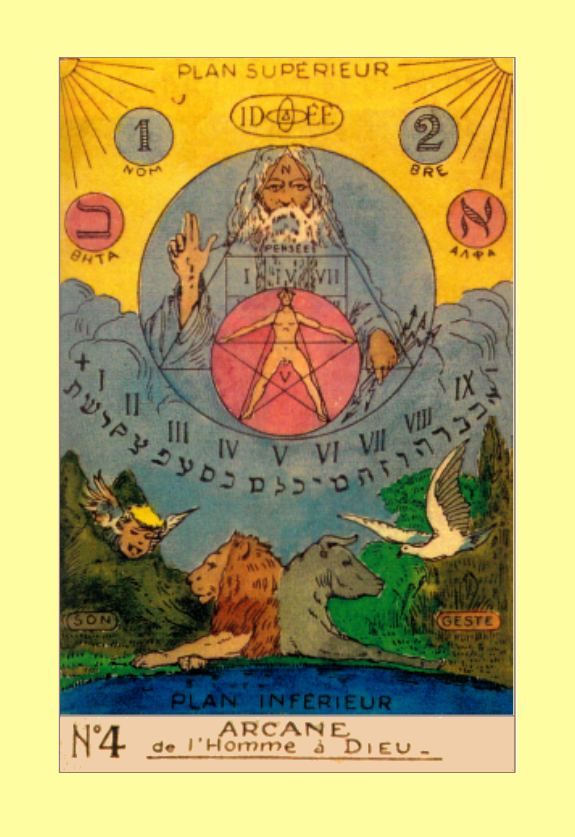
J'ai aussi conçu un Arcane Symbolique pouvant traduire par ce mode l'idée dominante de chaque chapitre pour ceux qui désirent méditer sur des objets utiles à l'évolution des Êtres. |
I have also conceived a Symbolic Arcanum that can translate the dominant idea of each chapter for those who wish to mediate on objects that are useful for the evolution of Beings. |
|
|
Par un SÐ IÑ |
By an SÐ UÑ |
|
ÉTUDE sur le TABLEAU Chapitre IV Par un SÐ IÑ La Revue EON 5 et 6 septembre-octobre 1923
|
Study of the NATURAL Chapter IV By a SÐ UÑ Revue EON 5 et 6 September-October 1923
|

|
ÉTUDE sur le TABLEAU Par un SÐ IÑ (Suite) La Revue EON 5 et 6 septembre-octobre 1923
Chapitre IV |
Study of the NATURAL By a SÐ UÑ (Sequel) Revue EON 5 et 6 September-October 1923
Chapter IV |
|
THÉORÈME I 89 L'Homme, porté par un instinct secret à dominer, soit par la force, soit par la justesse apparente de sa doctrine, semble par-là n'être occupé qu'à prouver l'existence d'un Dieu, et à la montrer à ses semblables. |
THÉORÈME I 89 A person carried by a secret instinct to dominate, whether by force or by the apparent correctness of their doctrine, seems by this, to be occupied only to prove the existence of a God, and to show IT to their peers. |
|
THÉORÈME II 90 L'Athée qui se déclare contre l'Être éternel, infiniment juste, ne fait que substituer le nom de cet Être par un autre. Loin de détruire son indestructible existence, il démontre sa réalité et toutes les facultés qui lui appartiennent. |
THEOREM II 90 The Atheist who declares themself against the eternal Being, infinitely just, merely substitutes the name of this Being with another. Far from destroying ITS indestructible existence, they demonstrate ITS reality and all ITS faculties that belong to IT. |
|
THÉORÈME III 91 Tous les Êtres de la nature étant l'expression visible des facultés créatrices du Principe Suprême, l'homme doit l'être à la fois, et de ses facultés créatrices et de ses facultés pensantes. 92 (Observation). L'Impie ne peut pas se soustraire à une loi qui lui est commune avec tout ce qui est contenu dans la région temporelle. |
THEOREM III 91 Since every Being of nature is a visible expression of the creative faculties of the Supreme Principle, a person must be, at the same time, its creative and its thinking faculties. 92 (Observation). The Impious cannot avoid a law which is common to everything contained in the temporal region. |
|
THÉORÈME IV
93
Avant que les choses temporelles aient l'existence qui nous les rend
visibles, il a fallu des éléments antérieurs et intermédiaires entre elles
et les facultés créatrices, parce que ces choses et les facultés dont elles
descendent, sont d'une nature très différente et ne peuvent être ensemble
sans intermède. -
|
THEOREM IV
93
Before temporal things have the existence that makes them visible to us,
prior and intermediate elements were necessary between them and the
creative faculties, because these things and the faculties from which
they descend, are of very different nature and cannot be together
without mediator. |
|
THÉORÈME V 94 Ces éléments intermédiaires, inconnus, mais dont l'intelligence atteste l'existence, sont déterminés dans leur essence et dans leur nombre. 95 Ils peuvent être regardés comme les premiers signes des facultés supérieures auxquelles ils tiennent immédiatement. |
THEOREM V 94 These intermediate elements that are unknown but whose intelligence is attested by their existence, are determined by their essence and their number. 95 They can be regarded as the first signs of the superior faculties to which they are immediately attached |
|
THÉORÈME VI 96 L'homme, dans ses œuvres, est lié, comme tous les autres Êtres, à ces signes primitifs; il ne peut imaginer aucune forme, il ne peut rien faire de volontaire ou d'involontaire qui ne tienne à ces modèles exclusifs. |
THEOREM VI 96 In their work, a person is bound, like all other Beings, to these primitive signs. They cannot imagine any form, cannot do anything voluntarily or involuntarily, that are not attached to these exclusive designs. |
|
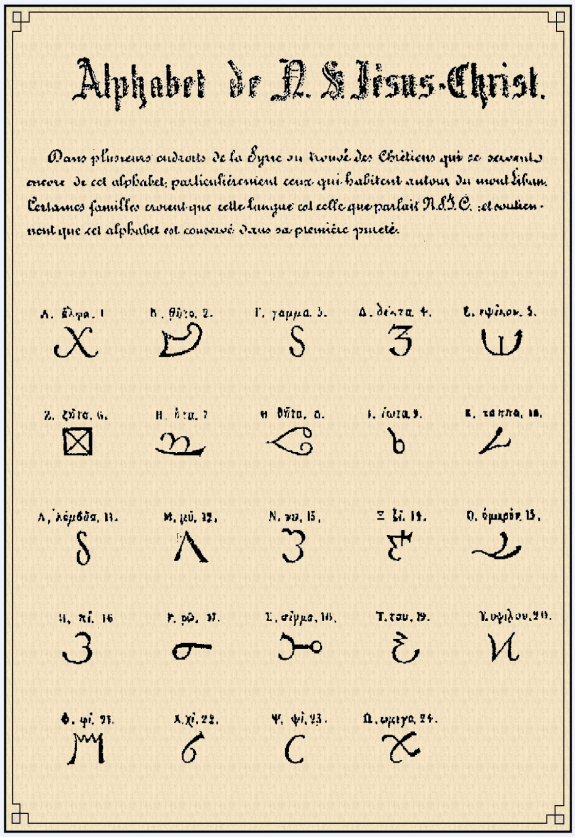
THÉORÈME VII 97 Il est certain aussi que les sons et les caractères alphabétiques, qui servent d'instruments fondamentaux de l'expression première de nos facultés pensantes, doivent tenir à des signes, à des sons antérieurs qui leur servent de base. |
THEOREM VII 97 It is also certain that the sounds and alphabetical characters that serve as the fundamental instruments of the primary expression of our thinking faculties, must stem from the signs and the prior sounds which serve as their basis. |
|
THÉORÈME VIII 98 Ces sons et ces caractères primitifs étant les vrais signes sensibles de nos pensées, ils doivent être aussi les signes sensibles de l'Unité pensante, car il n'y a qu'une seule idée comme il n'y a qu'un seul principe de toutes choses. --- Ainsi l'homme ne peut proférer une seule parole, tracer un seul signe qu'il ne manifeste la faculté pensante de l'Agent Suprême. |
THEOREM VIII 98 As these sounds and primitive characters being the true tangible signs of our thoughts, they must also be the tangible signs of the thinking Unity, as there is only one single idea just as there is only one principle of all things. --- Thus, a person cannot utter a single word or trace a single sign that does not manifest the thinking faculty of the Supreme Agent. |
|
THÉORÈME IX 99 Nous sommes donc fondés à dire que l'homme est le signe et l'expression des facultés universelles du Principe Suprême dont il est émané. |
THEOREM IX 99 Therefore, we are justified in saying that a person is the sign and expression of the universal faculties of the Supreme Principle from which they emanate. |
|
THÉORÈME X
100
Lorsque l'homme produit extérieurement quelque acte intellectuel, ce
mobile qui émane de lui et qui étant porté à d'autres
les fait agir ou il leur donne une vertu. Ce mobile,
dis-je, quoique sorti de l'homme, quoiqu'étant pour ainsi dire un extrait
de sa propre image, il ne l'en privera point d'en produire
des pareils.
|
THEOREM X
100
When a person externally produces an intellectual act, this impetus
that emanates from them, and which is directed towards others,
causes them to act or gives them a virtue. This impetus,
I say, although it comes out of the person it is, as it were, an extract
of their own image, it will not prevent them from producing similar
ones.
|
|
THÉORÈME XI 101 L'homme par ses propres faits nous annonce qu'il est émané des facultés divines, sans que ces dernières aient éprouvé, en l'émanant, ni séparation, ni division, ni aucune altération dans leur essence. |
THEOREM XI 101 A person by their own deeds, gives proof that they emanated from the divine faculties, without the latter having experienced in emanating them, either separation, or division, or any alteration in ITS essence. |
|
THÉORÈME XII 102 Se souvenant qu'il n'y a qu'un seul Auteur et Créateur de toutes choses, l'homme verra pourquoi dans ses œuvres il ne communique que des lueurs passagères, au lieu que cet Auteur universel communique l'existence même, et la vie impérissable. |
THEOREM XII 102 In remembering that there is only one Author and Creator of all things, a person will see why their works communicate only fleeting glimmers, compared to this universal Author communicating the existence itself, and the imperishable life. |
|
THÉORÈME XIII 103 Celle doctrine sur l'émanation de l'Étre intellectuel de l'homme s'accorde avec celle qui nous enseigne que toutes nos découvertes ne sont en quelque sorte que des réminiscences . |
THEOREM XIII 103 This doctrine of the emanation of a person's intellectual Being agrees with that which teaches us that all of our discoveries are, as it were, only remembrances. |
|
THÉORÈME XIV 104 Si nous sommes émanés d'une source universelle de Vérité aucune Vérité ne doit nous paraître nouvelle. 105 Nous voyons, dans les lois simples et physiques des corps, une image sensible de ce principe, que l'homme n'est qu'un être de réminiscence. |
THEOREM XIV 104 If we emanate from a universal source of Truth, no Truth should seem new to us. 105 We see in the simple and physical laws of bodies, a tangible image of this principle that a person is only a being of remembrances. |
|
THÉORÈME XV 106 L'homme intellectuel par sa primitive existence tient à son arbre générateur, il est pour ainsi dire, le témoin de tout ce qui a existé dans son atmosphère, et comme cette atmosphère est au-dessus de celle que nous habitons, et que l'Intellectuel est au-dessus du matériel, les faits auxquels l'homme a participé sont supérieurs, car étant lié à la Vérité, il a participé, quoique passivement, de cette Vérité. |
THEOREM XV 106 The intellectual person due to their primitive existence, is attached to their generator tree. They are, as it were, the witness of everything that has existed in their environment[1], and this environment is beyond where we live, and that the Intellectual is above the material, that the deeds that the person participates in are superior, is because being bound to the Truth they participate, albeit passively, in this Truth. |
|
THÉORÈME XVI 107 On peut ainsi dire d'avance, que tous les êtres crés et émanés dans la région temporelle et l'homme par conséquent, travaillent à la même œuvre, qui est de recouvrer leur ressemblance avec leur Principe leur arbre générateur. Voilà pourquoi l'homme ayant une réminiscence de Vérité prouve qu'il est descendu de cette même vérité. |
THEOREM XVII 107 One can say in advance that all the created and emanated beings in the temporal region, and consequently a person, labour at the same work which is to recover their resemblance with the Principle of their generator tree. That is why when a person has a remembrance of Truth it proves that he is descended from this same truth. |
|
(Fin des théorèmes démonstratifs) THÉORÈME XVII 108 L'homme est né pour être le chiffre universel, le signe vivant et le tableau réel d'un Être infini. Il est né pour prouver à tous les Êtres qu'il y a un DIEU. |
(End of demonstrative theorems) THEOREM XVII 108 Man was born to be the universal symbol, the living sign and the real representation of an infinite Being. He was born to prove to all Beings that there is a GOD. |
|
THÉORÈME XVIII 109 Heureux l'homme, s'il n'eut jamais annoncé Dieu qu'en manifestant ses puissances et non pas, comme le matérialiste, l'impie, et l'athée, en les usurpant. |
THEOREM XVIII 109 A person is blessed if they have only heralded God by manifesting ITS powers and not, like the materialist - godless and atheist, by appropriating them. |
|
THÉORÈME XIX 110 Les facultés de l'Étre Suprême sont infinies comme Lui; dès qu'il a mis sur l'homme l'expression de son nombre, il faut qu'il en ait les traces de son universalité. |
THEOREM XIX 110 The faculties of the Supreme Being are infinite like Him. As soon as IT placed on a person the expression of ITS number, the person must have the trace of ITS universality. |
|
THÉORÈME XX 111 L'homme ne peut ravaler ce Principe Suprême en portant son origine jusqu'à Lui, puisque toutes les productions sont inférieures à leur Principe générateur, puisque l'homme n'est que l'expression des facultés divines et du Nombre divin, et non pas de la nature même de ces facultés et de ce Nombre qui est le caractère distinctif de la Divinité. |
THEOREM XX 111 A person cannot lower this Supreme Principle by tracing their origins back to IT, since all creations are inferior to their generator Principle, since a person is only the expression of the divine faculties and the divine Number and is not of the very nature as these faculties and of this Number, which is the distinctive character of the Divinity. |
|
THÉORÈME XXI 112 L'homme, en général, ne vit dans la quiétude et n'est content de lui-même que quand il n'envisage pas ce qui est au-dessus de lui. 113 Si l'homme veut se préserver de toutes les illusions et surtout des amorces de l'Orgueil par lesquelles il est si souvent réduit, qu'il ne prenne jamais les Hommes, mais toujours Dieu pour terme de comparaison. |
THEOREM XXI 112 In general, a person does not live in tranquillity and is not content within themself only when they does not consider what is above them. 113 If a person wants to protect themself from all illusions and above all, from the beginnings of Pride to which they are so often reduced, they must never take People but always God as the standard of comparison. |
|
La fin de l'article dans la Revue EON |
End of article in Revue EON |
|
(À suivre) |
(to be continued) |
|
[1]
'son atmosphère' – literally the physical atmospheric air that above and around the person. |
No copyright is claimed for either the Emblem of the Order
or the title 'Order of the Lily and the Eagle'
© Commandery of Attica in the West
Étude sur le Tableau Naturel chapter 4